News / The Fair And Just Journal
Beyond the Verdict: Justice Is More Than a Conviction
By Jon’Dasha Price
Before I ever stepped foot in law school, I knew I wanted to become a prosecutor. But I also knew that I wanted to be part of changing the way our criminal justice system operates. My interest in prosecution was never rooted solely in securing convictions or obtaining lengthy sentences. Instead, I believed that prosecutors, entrusted with tremendous discretion and responsibility, could play a transformative role in creating a system that prioritizes fairness, accountability, and compassion.
That belief is what drew me to Fair and Just Prosecution (FJP) and ultimately led me to spend my summer as an FJP Summer Fellow with the DeKalb County District Attorney’s Office in Georgia. As someone who entered law school passionate about criminal justice reform, I was eager to see what those principles looked like beyond academic discussions and policy proposals. My summer in the office’s Domestic Violence and Sexual Assault (DV/SA) Unit provided that opportunity and reinforced something I had believed long before law school: justice is about far more than securing a conviction.
Throughout the summer, I conducted legal research, reviewed evidence, and observed hearings and trials. These experiences allowed me to move beyond the legal doctrines I had studied during my first year of law school and better understand the responsibilities prosecutors carry. While law school teaches us to analyze facts, identify legal issues, and apply the law, my internship reminded me that behind every case file and courtroom proceeding are real people whose lives are affected by the criminal justice system.
One aspect of my summer that impressed me most was the investment the DeKalb County District Attorney’s Office has made in its DV/SA Unit. With 10 attorneys, 10 victim advocates, and designated investigators, the unit brings together professionals whose different responsibilities contribute to the pursuit of justice. I was particularly struck by the victim advocates, whom I observed interacting with survivors and providing support during hearings and trials. Their work reminded me that the criminal justice process can be unfamiliar, intimidating, and emotionally exhausting for those asked to participate in it.
Observing their work reinforced something I believe is essential to public service: an organization’s values should be more than words on a piece of paper. The DeKalb County District Attorney’s Office has adopted a Bill of Values that provides 10 guiding principles for its approach to prosecution. Among them is a commitment to helping crime survivors heal by striving to meet their stated needs, even when there is insufficient evidence to pursue a case. The office also recognizes the importance of keeping victims informed and engaged throughout the criminal justice process, including providing opportunities to be heard during significant proceedings.
These commitments particularly resonated with me because they acknowledge that the responsibility of a prosecutor’s office does not begin and end with securing a conviction. Seeing the resources dedicated to the DV/SA Unit and observing the support provided by victim advocates demonstrated how written principles can be reflected in the everyday work of an office.
Two experiences in particular shaped my understanding of what justice beyond a conviction can look like.
The first involved a double-homicide case in which I assisted by reviewing evidence. As the case approached trial, it ultimately ended in a plea agreement. I remember feeling an overwhelming sense of relief when I learned the case had been resolved, not simply because it meant the case would not proceed to trial, but because a child witness would no longer have to testify about one of the worst moments of their life.
That experience brought to mind another principle in the office’s Bill of Values: the recognition that accountability and public safety must be pursued while also considering ways to minimize harm. A guilty verdict following trial is one way to achieve accountability, but it is not the only way. In this instance, resolving the case through a plea agreement also meant sparing a child from having to recount an unimaginably traumatic event in open court. It reminded me that prosecutorial decisions can have consequences extending far beyond the outcome recorded in a case file.
Another moment that stayed with me involved a survivor who testified against her abuser, facing him in court for the first time since escaping. I watched as she made it through her testimony without breaking down, despite the emotional weight of recounting her experiences in his presence. I was struck by her courage, but also by the extraordinary demands the criminal justice process can place on survivors. Her experience reinforced my appreciation for the victim advocates who support individuals through these difficult moments. It also reminded me that strength should never be measured by whether someone cries or how they express their trauma.
Although these experiences were different, both reinforced the same lesson: justice cannot be measured solely by the outcome of a case. Accountability matters, but so does the way individuals are treated throughout the process. Whether a case ends in a plea agreement or proceeds to trial, the dignity and well-being of those affected deserves meaningful consideration.
Beyond my work in the DA’s Office, the FJP fellowship gave me opportunities to engage with district attorneys from across the country and learn about their approaches to prosecution, leadership, and criminal justice reform. I also connected with other law students serving in prosecutors’ offices across different jurisdictions. Hearing about their experiences expanded my understanding of the challenges facing the criminal justice system and the different approaches prosecutors are taking to address them. These conversations reminded me that reform is not a single policy, program, or decision. It requires continuous reflection on how prosecutorial discretion is exercised, whose interests are considered, and how the justice system can better serve communities while preserving fairness and accountability.
I am incredibly grateful to Fair and Just Prosecution for providing this opportunity and to the attorneys, victim advocates, investigators, and staff at the DeKalb County District Attorney’s Office who welcomed me and contributed to my professional growth. Their willingness to share their knowledge and include me in their work strengthened both my understanding of prosecution and my commitment to pursuing this career.
I entered law school believing that prosecutors could play a meaningful role in reforming our criminal justice system. My summer in DeKalb County did not introduce me to that belief; it gave me a deeper understanding of what putting it into practice can require. I left the fellowship even more committed to becoming a prosecutor who approaches the pursuit of justice with integrity, empathy, and a recognition of the humanity of everyone affected by the criminal justice system. Because justice is more than a conviction. It is reflected in the values we uphold, the decisions we make, and the people we serve along the way.
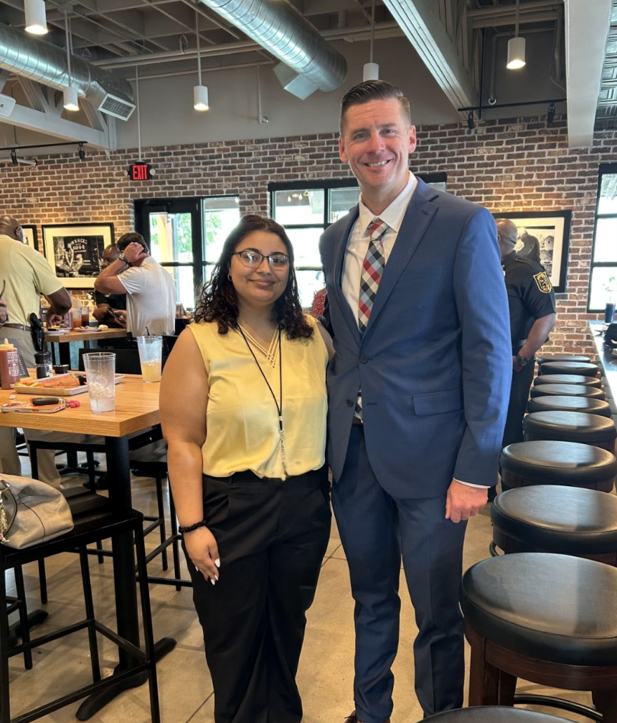
Jon’Dasha Price and Michael Costello, Senior Assistant District Attorney, Crime Strategies and Community Partnerships Unit